ATMs, Cash, and Money Tips for Morocco Solo Travelers
Once you know a few basic facts, managing money in Morocco is truly simple, but almost all individual travellers ask the same set of questions before they arrive, so let’s go over in detail exactly how it works, including the current fees.
The Moroccan Dirham Is a Closed Currency
The most important point to bear in mind before you begin packing is that the dirham, denoted as MAD, cannot be purchased outside Morocco and that exporting it from the country is restricted; therefore you can’t arrive in Morocco with dirhams in your possession and any excess amount should be exchanged or spent before you leave. As a general guide, one euro is equivalent to about 10 to 11 dirhams and one US dollar to about 9 to 10 dirhams, although the exchange rates do change, so it’s advisable to look up the current rate just before you travel rather than use a figure from an earlier post.
ATMs, Where You Will Get Most of Your Cash
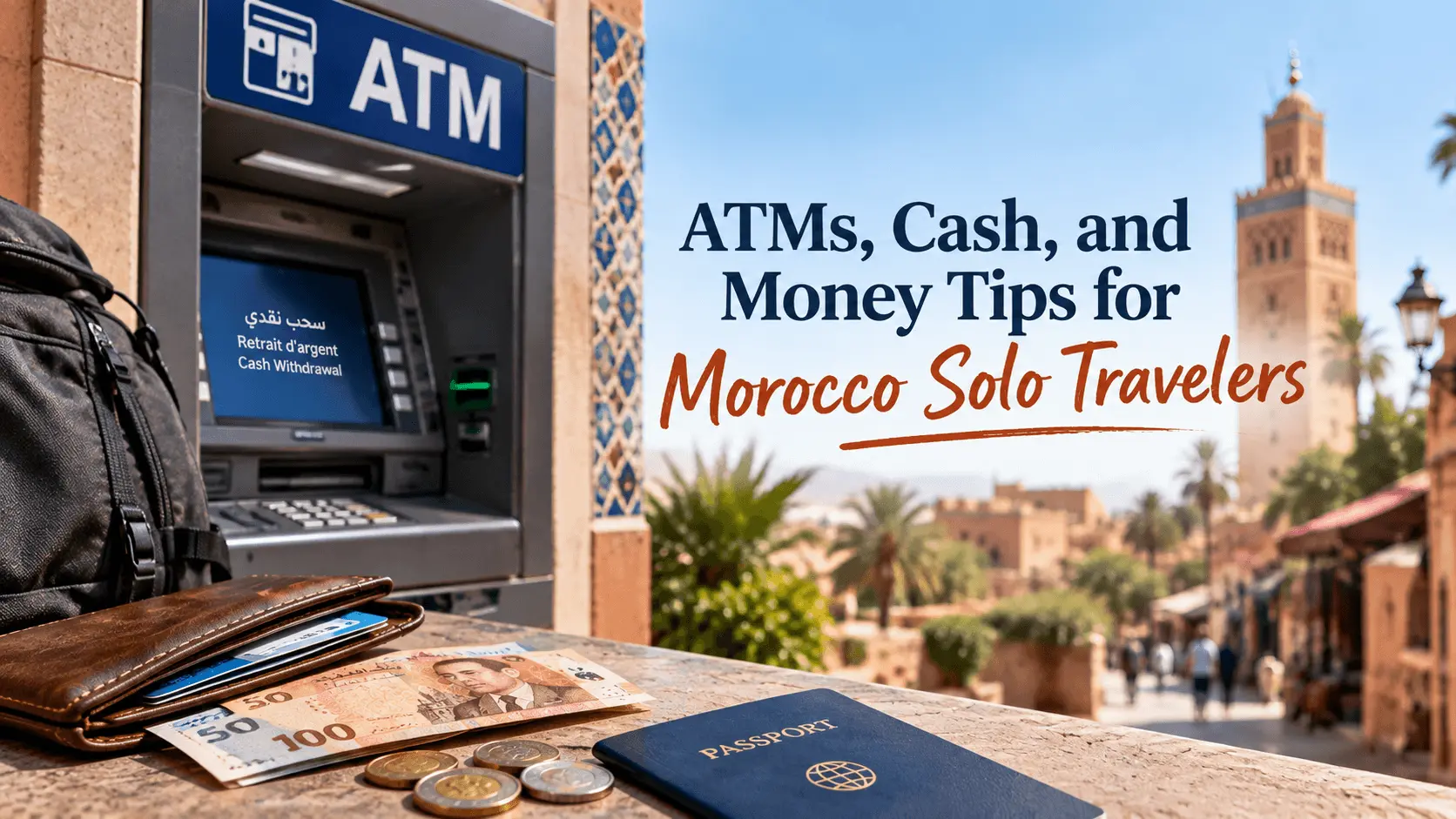
ATMs can be found in all the cities and in most of the larger towns as well; in Marrakech, Fes, and Casablanca there is one on almost every commercial street, and while Visa and Mastercard are both widely accepted American Express is accepted to a much lesser extent. The usual limit for each transaction when withdrawing money is about 2,000 dirhams, although with some banks and ATMs the limit goes up to 3,000 or 4,000 dirhams and a few of them, such as BMCI, have considerably higher limits which in some cases reach as high as 8,000 dirhams per withdrawal, something that is helpful if you prefer to make as few separate withdrawals as possible.
It is the fees that tend to catch people out. Most Moroccan banks impose a local withdrawal fee of about 20 to 40 dirhams per transaction in addition to any charges your own bank makes for international withdrawals, which is why it actually makes financial sense to make fewer, larger withdrawals rather than many small ones during a trip. There is one point that’s worth noting: Al Barid Bank, which had previously been a bank with no fees for cards from abroad, now charges a fee of 35 dirhams as from early 2026, so no bank can currently be counted on as offering a free service and it is still worth taking an extra minute to compare a couple of nearby machines before carrying out a withdrawal if the first one has an unusually high fee.
The One Screen Prompt That Actually Matters
At nearly all ATMs you will be given the option of being charged in dirhams or of asking the machine to convert the amount into your home currency at once. You should select dirhams, since the process known as dynamic currency conversion charges you a considerably less favourable exchange rate if the machine carries out the conversion; it is generally the better option to let your bank or card organisation carry out the conversion instead. The wording displayed on the screen can be a bit confusing, for example the phrases ‘accept conversion’ and ‘continue without conversion’, so take the time to read it carefully, as refusing the conversion does not cancel your withdrawal, it only makes sure that you receive a more reasonable rate.
Cash or Card, Where Each Actually Works
In cities, cards are generally accepted in hotels, riads, larger restaurants, supermarkets, and fuel stations. However, cash is still necessary when visiting souks, eating street food, going to small local restaurants, using a grand taxi, and for nearly all things in rural areas or in smaller towns. For a single traveller, a reasonable approach is to use a card for larger, planned expenses, for accommodation, for more substantial meals in restaurants, for tours that have been booked in advance, and to carry cash for all everyday spending.
How Much Cash to Actually Carry
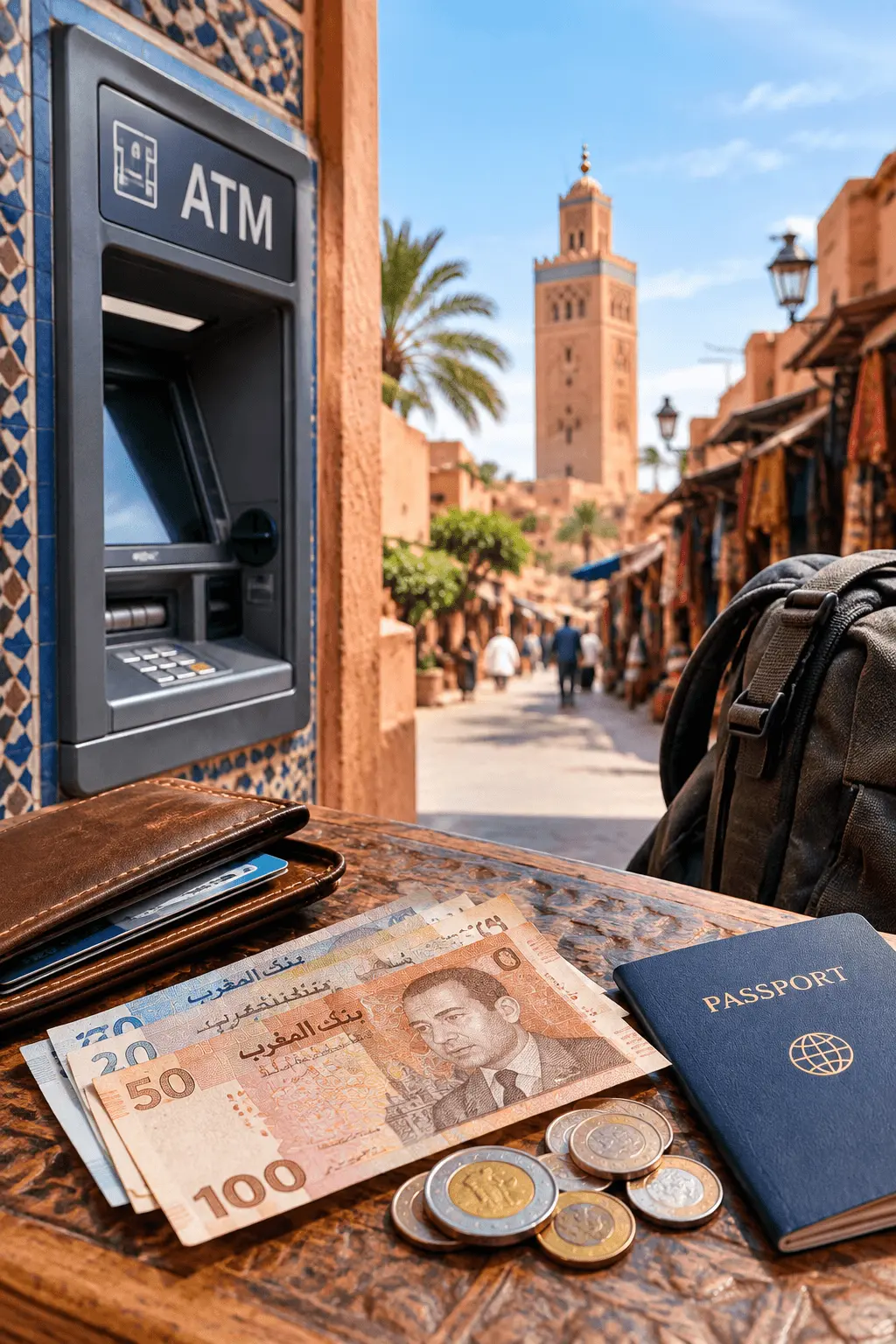
A daily expenditure of between 500 and 1,000 dirhams should be sufficient to cover your meals, local taxi fares, small entrance fees, and tips, with you needing to restock your money via ATM every few days rather than carrying a large sum at one time. It is a good idea to have a variety of denominations since banknotes are usually available in 20, 50, 100, and 200 dirhams and it is really useful to save up smaller coins and notes for use with taxis, tips and in cafes, as smaller vendors and drivers often cannot break a 200 dirham note, particularly early in the day. In the case of an ATM that only dispenses large notes, it is helpful to break one of them at a supermarket or a bigger café before entering a medina or rural area so as to avoid an embarrassing situation later on.
Currency Exchange Offices, a Solid Backup
The exchange offices located in cities and at airports publish their exchange rates openly and, by law, charge no commission, which is why exchanging money is worthwhile since the rates do differ slightly from one office to another. Airport exchange counters are reasonable when compared with international standards, so it makes perfect sense to exchange enough cash for your first day in the country before having found an ATM. If you intend to exchange cash directly, take with you clean euro or dollar notes that are relatively new, as worn or older notes may be given a poorer rate or might even be refused altogether. In any case, do not go for informal street currency changers at all, since this involves a real risk of being given counterfeit notes with no way of taking action afterward.
A Few Extra Practical Habits
It’s a good idea to inform your bank before you travel since many banks automatically prevent the first international withdrawal from a card without giving any notice, meaning that you’ll only find out about this frustrating and avoidable issue when you get to the ATM. If you don’t already have one, it’s worth setting up a fee-free travel card such as Wise or Revolut as this will not get rid of the local ATM charge in Morocco but will eliminate the foreign transaction fee from your home bank on top of that charge. Whenever possible, take money out during the day from ATMs that are located at actual bank branches, and make sure you have a spare card in case your card is declined or lost. In the event that your route includes the Sahara or remote mountain regions, you should buy as much cash as possible before you set off since ATMs become very rare away from the main tourist areas.
A Note From Living Here
It shouldn’t seem complicated when you actually get here, so take a reasonable sum out every few days, always opt for dirhams when using the ATM, and make sure you have a small amount of cash available before going to a remote area. Generally, individual travelers reach a stable routine with their money within the first day or two.
Quick Answers
Will I be able to buy Moroccan dirhams before I get there? Not at all, since the dirham is a closed currency and cannot be bought outside Morocco, you’ll have to withdraw some or exchange the money once you have arrived.
What is the cost of withdrawing money from an ATM in Morocco? Most banks impose a local fee of about 20 to 40 dirhams for each withdrawal, in addition to any charges made by your own bank, which means that making larger withdrawals less frequently is more cost effective.
When faced with the choice of taking money in dirhams or in my home currency at a Moroccan ATM, you should go for dirhams since if the ATM converts your money into your home currency it uses a considerably worse exchange rate.
How much cash should I take with me each day in Morocco? About 500 to 1,000 dirhams is enough to pay for daily meals, taxis, and small purchases, since ATMs are widely available and you can use them to get more every few days.
Should you choose to exchange cash or use an ATM in Morocco? ATMs work just as well and are convenient since they can be found almost everywhere in the cities, whereas licensed exchange offices provide a good alternative, particularly on your first day before you find an ATM.