Morocco Packing List for Solo Travelers
Arranging luggage for a trip to Morocco is more difficult than it should be, mainly due to the wide variety of climates the country has—ranging from cities, through mountains, the coast, and deserts—and sometimes all of these areas are included in the same journey. The solution is not to pack for a fixed number of days but rather to pack according to the climate zones that actually lie along your particular route. The following is exactly what we would truly bring, taking into account what solo travelers in fact end up needing.
Think in Climate Zones, Not Days
Morocco can be divided into about four regions, each of which is very different: there’s the Atlantic coast, which remains mild and refreshing all year long; the imperial cities such as Marrakech and Fes, which are hot in the summer and mild in the winter; the Atlas Mountains, where it gets truly cold and can even snow in winter; and the Sahara, which experiences extremely hot days and nearly freezing nights according to the season. Since most solo itineraries involve passing through more than one of these areas, it’s a good idea to take a small amount of layered clothing rather than a set number of daily outfits.
Clothing
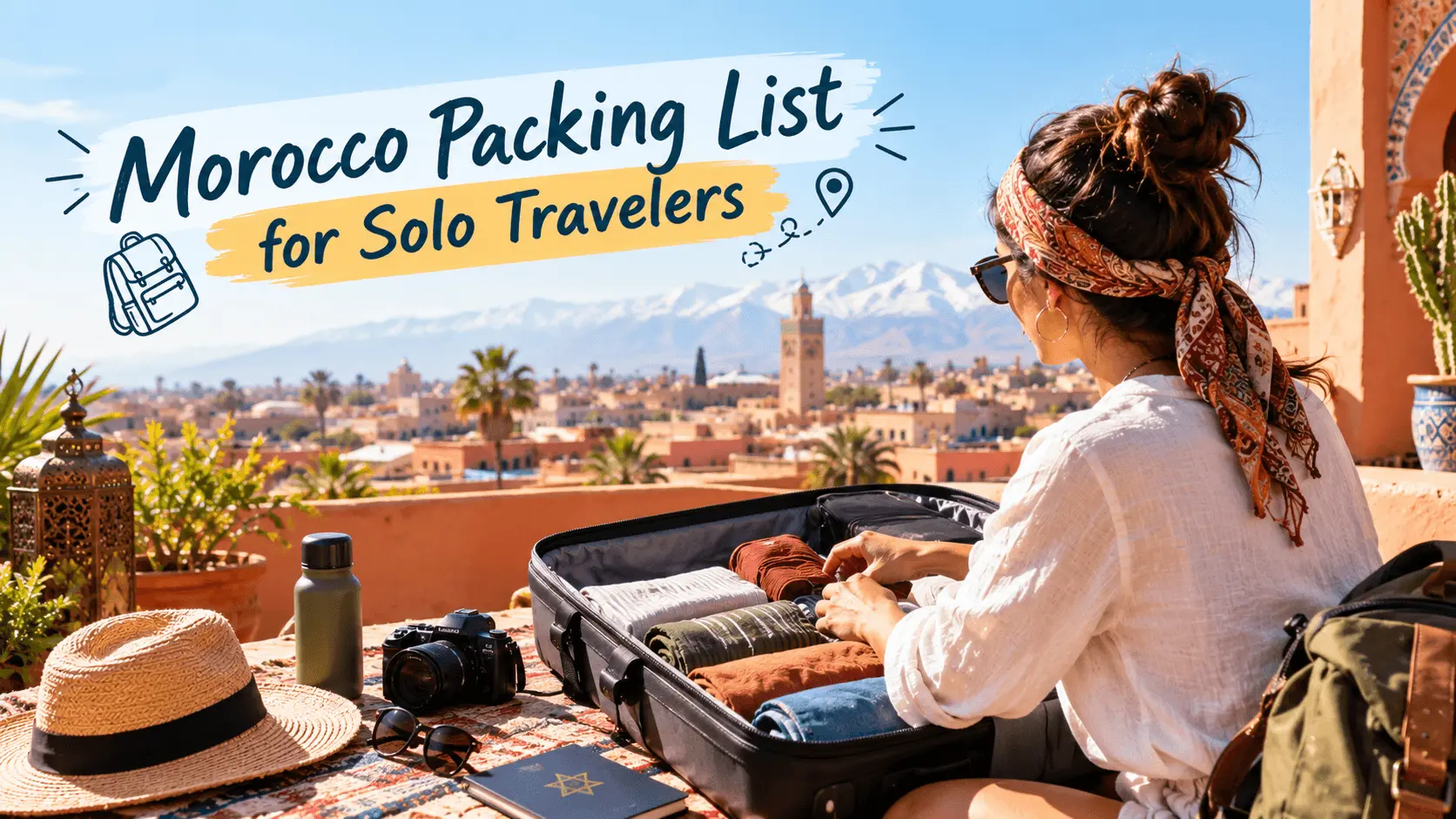
The practical choice is modest and breathable clothing, even though it is not legally required, since it is culturally appropriate and, to be honest, is more comfortable in hot weather than tight or very short clothing. For both men and women travelling through cities and medinas, loose cotton or linen trousers, maxi skirts or dresses, and tops that cover the shoulders are suitable. A light scarf or shawl takes up more room than almost any other item in your bag and can be used to cover the shoulders when necessary, to protect against dust and wind, to provide warmth when travelling or in the evening, and occasionally when visiting a mosque where women are expected to cover their heads.
Whatever the season, take at least one suitable warm layer with you, for example a fleece or a light packable jacket. In the case where your route involves a camp in the Sahara desert or the Atlas Mountains, you should pack your night clothes as well as a layer which is warm enough to cope with night-time temperatures that may drop between zero and five degrees Celsius, even though the daytime sun is strong. It is this one point that surprises more first-time visitors than any other item on this list.
Here, comfortable walking shoes that are worn in are more important than almost any other single item, the reason being that medinas have cobblestone streets, are uneven, and require a lot of walking. A dependable pair of closed trainers or walking shoes with good grip is sufficient for covering city streets, hiking, and day trips, and it’s worth having a second pair of sandals for Riad and coastal areas. When your trip includes some time at the beach, it’s all right to take a swimsuit since the rules at beaches and pools are relaxed, but it’s still a good idea to have some modest clothing for when you’re going to and from the water.
Safety and Health Basics
It is worthwhile to pack a simple first aid kit containing the basics such as blister plasters, antiseptic wipes, pain relievers and rehydration salts rather than expect to easily find an identical kit elsewhere. You should also take any medication that you take regularly together with a copy of your prescriptions. Sunscreen with a protection factor of 50 or higher and a wide-brimmed hat or cap are a must, since the sun is more intense than it appears even on mild or overcast days and fair-skinned people travelling in the winter are often surprised by it. A refillable water bottle is actually a useful addition, particularly when hiking or spending a lot of time outside of the main cities. Insect repellent should also be included, particularly when it is evening in coastal or rural areas.
Documents and Money
It is advisable to keep separate from your actual passport copies of the passport photo page, the entry stamp, the travel insurance policy, and any hotel or tour bookings. For navigating busy medinas, a cross body bag with a zip closure is a small but really useful improvement on an open tote, and it is a good idea to bring TSA-approved luggage locks for use with lockers, day bags left in the riads, and checked luggage.
Take with you a few different ways of paying since cash is necessary in souks and in smaller towns, while cards are acceptable in larger hotels and shops. It makes sense to arrange a card before you leave home that has either low or no foreign transaction fees.
Tech and Connectivity
Sort your eSIM or local SIM either before you arrive or as soon as you have arrived, for more information on the best eSIM options in Morocco please see our full guide. Take a universal or Type C and E power adapter because Morocco uses the European style two pin plug and also take a portable power bank since a full day of navigating alone with the maps running on your phone will quickly drain your battery.
What You Probably Do Not Need
There are several pairs of shoes in addition to one sturdy pair for walking and one casual one. The suitcase contains a full set of just in case clothes, and it is easy and inexpensive to get laundry at most guesthouses and riads. Rather than taking a printed book with you all day, heavy printed guidebooks, a well-saved collection of offline maps and a few bookmarked posts satisfy most of the practical needs.
A Note From Living Here
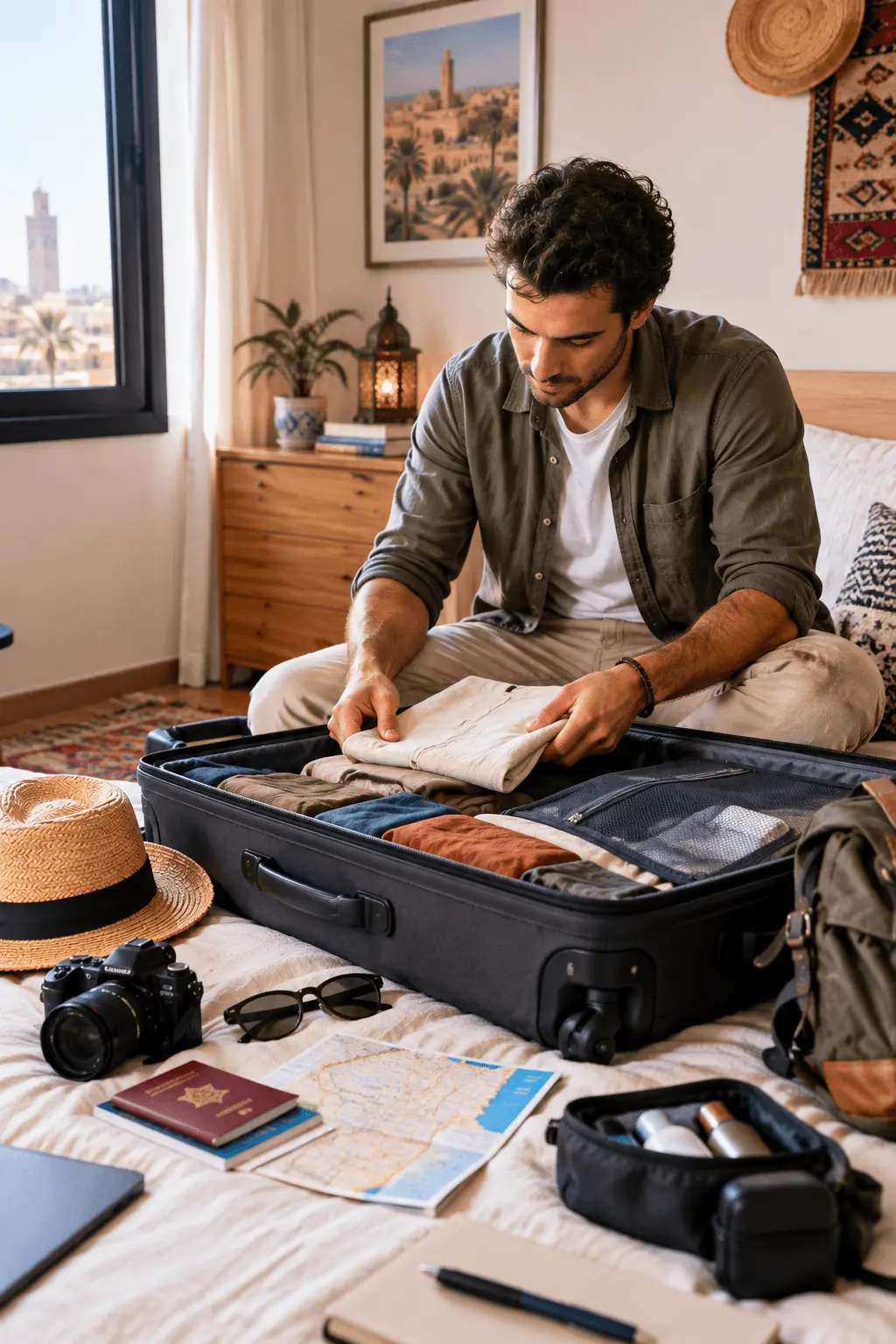
When visiting the Sahara, it is necessary to pack more warmly even though your instinct might lead you to do otherwise. Night temperatures in the desert really do surprise people since they drop quickly after sunset, and a single fleece is usually not sufficient by itself; instead, a proper layered system with a warm base layer makes a real difference to the amount you actually enjoy that section of the trip rather than enduring it by shivering.
Quick Answers
In Morocco do I have to cover my head? Only if you are a woman entering a mosque, since in most everyday situations it is not necessary to do so, though it is still a good idea to have a scarf for convenience.
Is it safe to wear shorts or tank tops in Morocco? Yes, you can do so, especially in more touristy areas, in coastal towns, and near pools, but more modest clothing usually attracts less unwanted attention and is generally more comfortable when dealing with the heat and dust encountered during everyday walking.
For Morocco, the best shoes are comfortable ones which have been worn in before, since the streets of the medina are uneven and tend to be slippery when wet, and you should also take a pair of sandals for the riads and the warmer coastal areas.
How cold actually gets in the Sahara or the Atlas Mountains? During winter the temperature can fall to near freezing and, even in the transitional seasons, desert and mountain nights are considerably colder than the daytime heat indicates, so a properly warm layer is a necessity, not something optional.
Shall I take my own toiletries with me? Although basic toiletries can be found in pharmacies in most cities, it’s still a good idea to bring some for your first one or two days—especially if you have a preference for a particular brand or have special skin requirements—because smaller towns generally have a more limited choice.