A genuine guide to the question of whether Morocco is safe for women travelling alone
This is the question that almost every woman poses before arranging a trip to Morocco, and it calls for a direct answer rather than one that has been polished for the brochure or one that is based on fear. So here is the answer: yes, Morocco is usually safe for single female travelers, and hundreds of thousands of women visit there on their own each year and return with tales concerning hospitality, mint tea, and sunsets over the Sahara, not tales of danger. Nevertheless, safety doesn’t mean that it’s exactly like traveling back home, and Morocco does require a certain level of cultural understanding as well as a few practical habits if the experience is to be smooth rather than stressful.
What the Official Advisories Actually Say
According to the latest update, the US State Department has rated Morocco at Level 2, recommending increased caution primarily due to terrorism concerns rather than because of ordinary street crime, and it tells visitors to remain vigilant in crowded tourist areas, markets and transport centres—a general recommendation that is commonly given for many popular destinations around the world. It is important to distinguish this advisory from the issue of personal safety for a single woman, since the advice is based on the overall security situation and not on any gender-specific risk. Violent crime against tourists in Morocco is genuinely uncommon, and the country is consistently ranked as one of the safest in Africa and the wider region for travelers.
The Real Risks, Honestly
The kind of problems that individual women most frequently mention aren’t cases of violence but rather verbal attention—such as comments, stares, and persistent vendors or self-appointed guides who try to sell you a tour, a shop, or directions even though you didn’t ask for them. This kind of experience can be quite intense in crowded, busy areas like Marrakech’s Jemaa el Fnaa or the Fes medina, especially during the first day or two while you’re still getting used to your routine. Scams are also another kind of thing it’s important to be aware of, for example taking you on a taxi at an excessive price, false guides who take you to a place and then ask for money, or shopkeepers giving inflated prices to strangers. Although this sort of thing isn’t dangerous in the way the word suggests, it can be genuinely annoying if you’re not expecting it, so having this knowledge beforehand greatly reduces the annoyance.
Morocco is generally seen as much easier and more peaceful for single women than Egypt or certain areas of the wider Middle East, especially in the more tourist-friendly cities.
What to Wear, and Why It Actually Helps
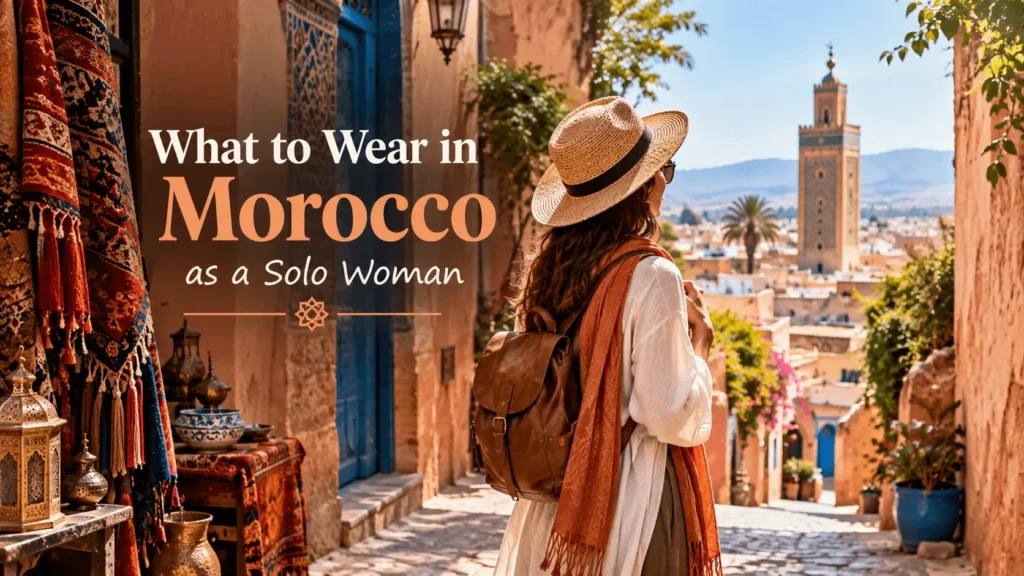
Morocco is a country where Muslims form the majority and where social customs concerning clothing are conservative, so you don’t have to dress like a local, but the clothes you choose do make a difference in the amount of attention you attract. Wearing loose, breathable garments that cover both your shoulders and knees, long trousers, maxi skirts or dresses, and looser tops generally leads to a noticeable decrease in unwanted attention when compared to wearing tight or very short clothes. This has nothing to do with blending in completely; it’s simply a practical compromise that most women travelling alone will say is worth making, particularly in the medinas and in smaller towns. The relaxation of this rule is somewhat evident in coastal towns and resort areas, especially near pools and beaches.
Handling Unwanted Attention
Women who have actually carried out the trip repeatedly advise staying calm, remaining confident and not feeling it is necessary to be polite when someone is persistent. Simply saying a firm and clear “la shukran”, no thanks in Darija, while at the same time continuing to walk, deals with the vast majority of situations. Trying to engage, argue or go into too much explanation generally tends to lengthen the interaction rather than bring it to an end. This is more a learned skill than a personal trait, and most solo women say that it becomes automatic within the first couple of days.
Choosing Where to Stay
Traditional courtyard guesthouses known as riads in Morocco are usually a good and safe option for single women, especially those run by families and staffed with attentive personnel who have a truly friendly atmosphere. When making a reservation, it is important to choose one that is situated in a busy, well-tracked area of the medina rather than in a remote alley, with recent positive comments from other single travelers, and preferably one that has a reception open 24 hours a day since this makes it much easier to arrive late or to need assistance at unusual hours.
Getting Around Safely
The small city taxis, which are coloured to match the city—red in Marrakech, blue in Rabat, and so on—are a safe and ordinary means of getting around, provided that you check the meter is working or agree on a reasonable fare before getting in, since the problem of being overcharged by taxi drivers is far more frequent than any real safety issue. If you need a taxi in the evening, it’s a bit easier to arrange one through your riad than to ask a stranger for a ride on the street, especially on your first few nights in a new city.
Cities That Tend to Feel Easiest for Solo Women
Moroccan cities are not all alike. The laid-back coastal town of Essaouira is often mentioned for the lack of street harassment and for having a compact, easy-to-navigate medina, which makes it a truly comfortable place in which to establish yourself at the beginning of a trip. Likewise, Chefchaouen, the blue city in the north, has a calm and relaxed atmosphere. Although Marrakech and Fes are entirely manageable, they do have heavier crowds and more persistent vendors, so it is realistic to allow a bit more patience when visiting those two.
Should you go for a guided tour rather than choosing to travel completely on your own?
It doesn’t have to be the case, but it’s worthwhile knowing about it as a possibility, especially when it comes to certain parts of a journey such as a trip into the Sahara desert. Instead of travelling that particular section on your own, you can join a small group tour, which will provide you with company, a guide to look after the arrangements and sales, and immediate travel companions, all while still keeping the rest of your trip as independent travel.
Quick Answers
Is it safe for a woman to travel entirely on her own in Morocco? Yes, generally, provided that one is aware of the fact that persistent verbal attention and small scams are the practical problems to anticipate, not violent crime.
When travelling in Morocco as a single woman what is best to wear is loose and breathable clothes that cover your shoulders and knees since this actually cuts down on unwanted attention although the standards are more relaxed at beaches, pools and resorts.
The Moroccan cities that are easiest for women traveling alone are Essaouira and Chefchaouen, while Marrakech and Fes need a bit more patience because of the larger number of people and the persistent presence of street vendors.
The way to deal with catcalling or persistent vendors is to simply say calmly and firmly “no, thank you” while still walking on; this settles most cases. Getting involved or arguing usually has the effect of lengthening rather than ending the interaction.
Is it safe for single women to stay in riads? Yes, especially in riads run by families, located in the more populated areas of the medina and having good recent reviews with a reception that is open 24 hours.
It’s quite normal to still be uncertain after having read this, especially when you’re about to go on your first solo journey to someplace you’re unfamiliar with, and this uncertainty usually disappears quickly once you actually arrive and get oriented.