Common Tourist Scams in Marrakech, and How to Avoid Them
Marrakech is truly one of the most rewarding cities in Morocco to visit and it is, in fact, one of the most thoroughly documented places where tourist scams take place. The city is by no means dangerous since these are mostly non-violent, minor annoyances rather than anything serious; however, by knowing the various scams in advance you can turn a frustrating first day into a trouble-free one. The following are the actual situations that occur, according to current travel reports, together with exactly how to avoid each one.
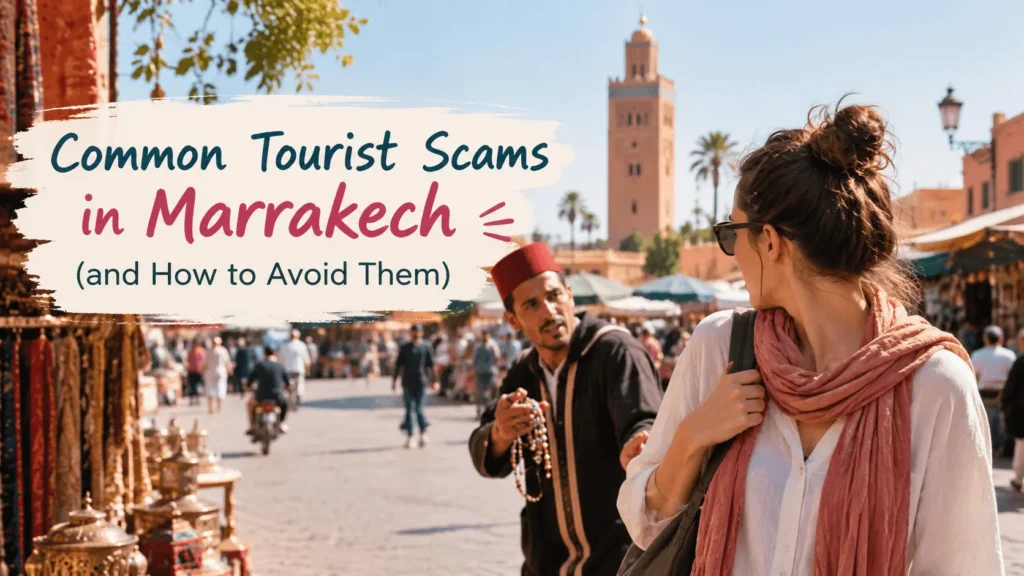
The Fake Guide, “The Road Is Closed”
It is the scam most commonly known in Marrakech and takes place in almost exactly the same way each time. A person will come up to you near the entrance to the medina, usually close to Jemaa el Fnaa or at the corner of the Café de France, and say that the street in front of you is closed, blocked, or that you should take a different route. They will then offer to show you the way, and at the end of the encounter will ask for money, try to push you into a shop, or simply take you directly to a business that pays them a commission. The road is, as a rule, entirely open. The solution is easy: walk on calmly, use offline Google Maps instead of appearing lost, and clearly say “la shukran”, no thank you, without stopping to discuss it. Official licensed guides have visible ID cards, and if you truly want a guide, you should book one through your riad or at the tourist office rather than taking one who approaches you on the street.
The Petit Taxi Meter Scam
Taxi drivers, especially in tourist areas and near the airport, will at times say that the meter is not working and give you a fare that is a number of times higher than the real charge; a journey which the meter would show as costing about 15 to 20 dirhams might be quoted at 100 to 200 dirhams or even more, particularly at night. Make sure to ask for the meter before getting into the taxi, and if the driver refusess to honour it, just go and get the next one. At Marrakech airport specifically, there is an official taxi ticket booth situated opposite the terminal exit, so you should buy your ticket there at the fixed rate before going to your car, thus eliminating any need for negotiation.
The Argan Oil and Carpet Shop Commission Trap
A kind stranger will offer to help you for free in finding your hotel or a particular landmark and then take you into an argan oil co-operative or a carpet shop. He or she gets a commission of about 30 to 50 per cent on any purchases you make, which is the reason why prices in these shops are generally considerably higher than in those intended for local people. The best way to avoid being directed to these places is to politely turn down any unsolicited assistance, even if it appears completely harmless.
The Tannery “Tour”
It is similar in structure to the argan oil trap and here specifically focuses on tourists who are near Souk Chouara in the northeastern part of the medina, an area that contains the leather tanneries. A person will offer to show you “the best view” of the tanneries and then ask for a fee or put pressure on you to make a purchase. However, if you would like to see the tanneries, most reputable riads can direct you to a genuine and reasonably priced method of visiting.
Snake Charmers and Monkey Handlers in Jemaa el Fnaa
In the main square snake charmers or monkey handlers will frequently ask tourists to take a photograph of them and then loudly ask for money afterwards, sometimes charging a large sum. Even if you had not agreed on a price in advance, there is no obligation upon you to pay whatever they demand, but the easiest thing to do is to completely avoid interacting with such situations unless you have already settled on a clear price.
Overpriced Restaurants Right on the Square
Restaurants that are situated directly on or right in front of Jemaa el Fnaa and other squares popular with tourists generally charge a lot more than similarly good, if not better, ones just a few streets away, even though the quality of the food doesn’t always correspond to the higher price. By checking the reviews in advance and being willing to walk a short distance past the main square, you will usually end up with better food at a lower cost.
Fake or Unofficial Tour Bookings
In the medina there are some people who offer unofficial excursions, such as trips to the desert, with unclear prices, no definite route, and no reviews that can be verified. This kind of activity has also spread online, with fake tour agencies showing up on social media where they take a deposit and then vanish. It is safer to book through a well-established company that has verifiable reviews or to ask the staff at your riad directly, since they almost always know which local operators are genuine if you want to go on anything more than a simple day trip.
Unsolicited Henna and Currency Exchange
A henna artist can apply a design to your hand without first agreeing on a clearly stated price and then ask for a high fee when the work is completed. Make sure you have agreed on an exact price before anyone touches you with henna. In the same way, do not use the informal currency exchange available on the street but should instead use licensed exchange offices or banks, as informal exchanges do involve a real risk of receiving counterfeit notes.
A General Rule Worth Remembering
Almost all the scams listed have the same basic pattern: they begin with unsolicited help and then ask for money after you’ve already committed to them. If anybody offers you something that you didn’t request—such as directions, a photograph, a recommendation for a shop, or a ‘special deal’—that should be a clear sign on which to politely say no and to move on. Simply adopting this habit alone stops the vast majority of such situations before they even begin.
A Note From Living Here
Scam awareness should improve your ability to judge, rather than cause you to suspect everyone you meet. Since the vast majority of the people you come across in Marrakech—such as shopkeepers, restaurant staff and riad owners—are truly friendly and have no intention of scamming anyone, most visitors discover that after just one or two days it becomes second nature to pick out these particular patterns and that their anxiety disappears almost completely.
Quick Answers
The scam that occurs most often in Marrakech is the one involving the fake guide or the “the road is closed” trick close to the entrances of the medina and at Jemaa el Fnaa, after which come the excessively high fares charged by the petit taxis.
What ought the fare of a petit taxi to be in Marrakech? For short journeys within the city the charge usually ranges from 15 to 20 dirhams on the meter, therefore if you are given a price much higher than this, particularly if a fixed rate is offered rather than using the meter, it is a good idea to look for another taxi.
Is it safe to accept help from a stranger in the medina? It is better to politely refuse any unsolicited help, even if it appears to be friendly, since this is the way most scams in the city begin.
Isn’t it the case that these scams are dangerous? No, for the most part they are not violent and are motivated by financial gain rather than by any threat; their aim is simply to get away with a small amount of your money, not to cause harm.
There is no need to avoid Jemaa el Fnaa due to scams; in fact, it is one of the main attractions when in Marrakech, provided you are aware of the particular tricks associated with snake charmers, uninvited guides, and street photography and thus be able to make the most of your visit.